
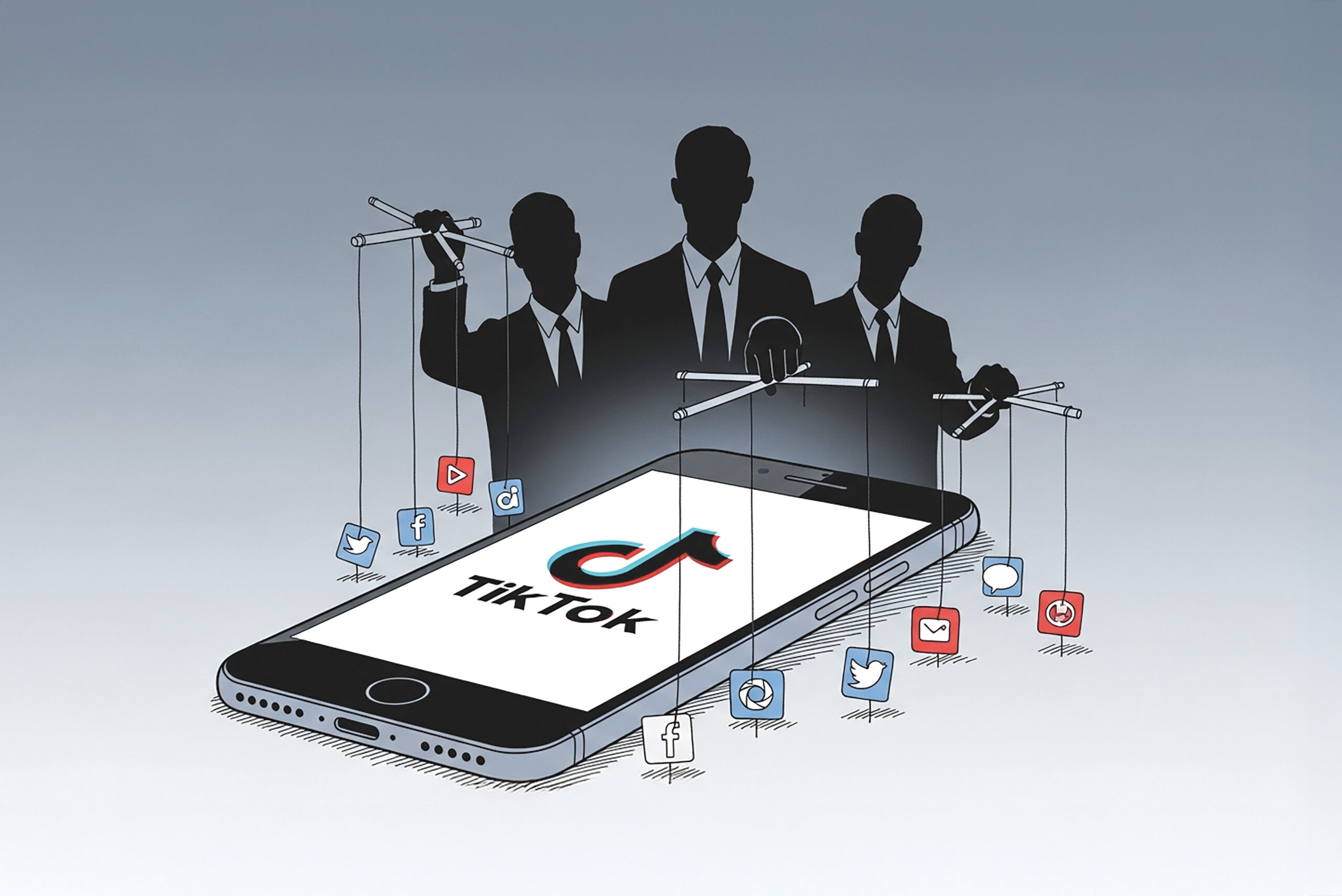
When the services invest in “media freedom”
In March 2022, three weeks after Moscow’s aggression against Ukraine, Kareem Dennis, a British rapper (performing under the name Lowkey) and political commentator, wrote on Twitter: “Greg Anderson, the current TikTok live-streaming manager for Europe, the Middle East and Africa, worked on NATO psychological operations. This is not how a free society works.”
In 2020, President Donald Trump signed an executive order that was to shut down TikTok within 45 days unless it was sold to an American buyer. The Chinese platform, the U.S. government claimed, posed a serious threat to the national security of the United States. TikTok is a Chinese company, but one operating only outside China. Its domestic market is served by a sister app, Douyin, which functions in a similar way but is separated by the Great Firewall from the global TikTok. As a result, there is no contact or flow of content between them. After Douyin’s success in China, its parent company, ByteDance, launched TikTok.
The Chinese tech giant first struck a deal to sell TikTok to Microsoft, and then to Oracle and Walmart. However, at the beginning of 2021, the Biden administration, without explanation, quietly suspended the sales requirement indefinitely, stating in court documents that it had “begun a review of the security concerns invoked by the Trump administration.”
Why such a decision? MintPress News, from which I have drawn information, writes: “analysis of the earlier careers of dozens of key TikTok employees suggests that rather than destroy TikTok, the U.S. national security state may have taken it over.” Now that is interesting! Social media in the service of security? Yes, a lot points that way. Since 2020, there has been a rapid influx of former agents, spies, and mandarins of the national security services into influential positions at TikTok, especially in areas tied to messaging content and policy. Some of them, at least on paper, do not appear competent to hold such functions.
MintPress provides several examples of people who joined social media teams
to steer the content found there and influence platform policy. Alexander Corbeil, while serving as head of content policy shaping at TikTok Canada, is simultaneously vice president of the NATO Association of Canada, an organization funded by NATO. Another new person in TikTok’s administrative structures linked to NATO is Ayse Koçak, the company’s global product policy manager. Before joining the social platform in 2024, she spent three years at NATO. Meanwhile, Foard Copeland, who works on TikTok’s trust and safety policy, was employed as an official at NATO as well as at the Department of Defense. Perhaps most troubling from the perspective of the public interest is the hiring of the above-mentioned Greg Andersen. According to his LinkedIn profile, until 2019 Andersen worked on “psychological operations” for NATO. According to MintPress contributor Lowkey, this information was removed after his tweet, quoted at the outset, went viral.
In October of this year, Alan Macleod of MintPress News wrote that the security apparat had not only taken over TikTok, because “a series of MintPress News investigations has uncovered a network of hundreds of former CIA, FBI, and other agency officers, as well as high-ranking State Department and NATO officials, working at social media giants such as Facebook, Google, TikTok, and Twitter. These individuals are overwhelmingly hired into managerial roles in politically sensitive departments such as trust and safety, protection and content moderation, meaning these former spies and intelligence officials help influence what billions of people around the world see, read, and hear (and decide who is promoted and who is suppressed) [emphasis added – R.K.].” Let us add that the investigations that exposed these scandalous practices lasted several years.
Many of the people whose profiles were created by MintPress deleted the accounts and pages that revealed their past. Others simply removed incriminating evidence from their biographies.
A perfect example is Aaron Berman. Berman is the Global Head of Content Policy at Meta, the parent company of Facebook, Instagram, and WhatsApp. As he himself says, this role makes him head of “the team that sets the rules for Facebook,” deciding “what is acceptable and what is not” for the platform’s 3.1 billion users. Aaron Berman is a CIA agent. Or at least he was one until July 2019, when he resigned from his position as a senior analysis manager at the Agency to take a job as senior disinformation manager at Meta. Since MintPress publicized this information, Berman has deleted his LinkedIn and Twitter accounts.
The journalistic investigation showed that he is not the only former “deep state” official, as Alan Macleod described service people, who became a social media manager while removing inconvenient facts from an online résumé. The columnist, by way of example, lists several names, including Dawn Burton of the FBI, who took a managerial role in the legal, public policy, trust and safety department at Twitter; Jeff Carlton, a longtime intelligence analyst at the CIA and FBI and at Twitter a program manager for trust and safety; Hayley Chang, deputy assistant director of the FBI, who left the Bureau to become director and deputy general counsel at Meta, where she dealt with cybersecurity and investigations; or Ellen Nixon, a former FBI agent currently heading the investigations of threats unit at Facebook.
Another example of removing incriminating evidence is Bryan Weisbard. Weisbard’s public profiles were used as evidence in two MintPress News investigations: “National Security Search Engine: CIA Agents Work at Google” and “Meet the Former CIA Agents Deciding Facebook Content Policy.” On his LinkedIn profile one could read that from 2006 to 2010 he was a CIA intelligence officer, commanding “global teams conducting counterterrorism and digital cyber threat investigations” and “identifying disinformation, propaganda, and covert influence campaigns on social media.”
He then moved to the State Department, becoming a foreign service officer. In 2015, however, he was transferred to Twitter, where he was appointed director of online safety operations, safety analysis, and investigations. Weisbard worked at Twitter for four years, and later became director of trust and safety at YouTube, leading global teams designing and implementing content moderation rules on the platform. In 2021–2025, he was a director of product management at Meta.
MintPress investigations revealed that hundreds of national security agents are pulling the strings at the most important platforms in Silicon Valley. No wonder, then, that they so quickly delete their profiles and hide evidence of their earlier activity in the special services.
One thing they cannot hide: their presence in administrative structures is proof that social media freedom, if it ever existed at all, belongs to the past. Free speech has been taken under the tender (and vigilant) care of outstanding specialists in establishing “truth.” Whoever does not understand this will wear the proverbial mask for the rest of their life, believing they are doing so “for their own good and that of others.”