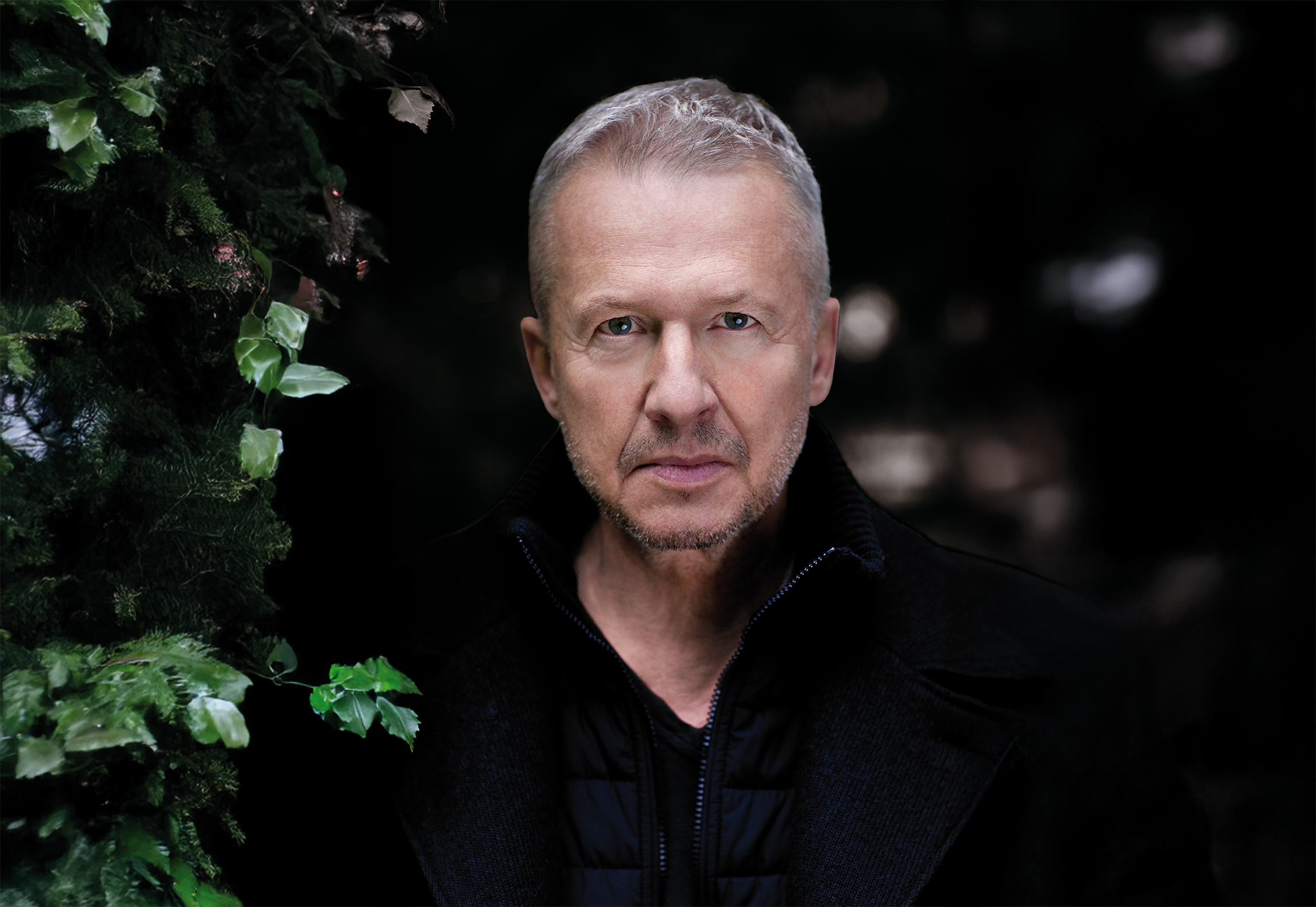
Bogusław Linda – A SENSITIVE TOUGH GUY
Not everyone remembers that Linda’s stage career began on a high note. No fearless macho with a gun! Instead—a hero grappling with a profound moral conflict.
“And you, Boguś, you’re a classic!”
“More like a young god. And I think I know what Poles might want from a bank.”
“What’s that?”
“Everyone wants something different, but above all—peace and quiet!”
That isn’t a movie dialogue, but a snippet from a commercial for one of Poland’s biggest banks featuring Bogusław Linda, Szymon Majewski, and Sara James. And here’s a line that Linda’s fans will recognize instantly—the famous quote from Psy (Dogs), in which Franz Maurer, on the phone with the girlfriend who betrayed him, snaps: “I don’t feel like talking to you.”
“Well, I like going to the bank to see Ms. Ala, because I like chatting with her,” Linda shoots back at Sara James as she praises the remote-transfer app.
It’s not Linda’s first ad campaign. After a longer absence from the silver screen, he returned to the spotlight, and fans were electrified by the fall premiere of the Linda–Pasikowski duo’s (reportedly) final film, Assassination of the Pope. Earlier he appeared in ads for T-Mobile, Renault Polska, Johnnie Walker whisky, Bols Platinium vodka, the Cinemax movie channel, Burger King, the Pharmaton Geriavit supplement for seniors, the Americanos jeans brand, and most recently Tyskie beer. Taken together with several social campaigns, that makes for an impressive advertising filmography. No wonder: Bogusław Linda’s image is a powerful recommendation for many brands, underscoring the high quality of their products.
Bogusław Linda truly earned his commercials. Although many people today associate him primarily with Psy and Franz Maurer—the gun-toting tough guy from Pasikowski—he won me over with roles that revealed great sensitivity and emotional depth, for example in Agnieszka Holland’s A Lonely Woman (a disabled lover and confidant of a solitary postwoman) or in Andrzej Wajda’s Pan Tadeusz (the unforgettable, searing confession of Father Robak). One way or another, he’s an actor with a very rich range—able, like a chameleon, to inhabit almost any character, making it non-obvious, multilayered, mysterious.
Not everyone remembers that Linda’s acting path in the theater began on a high note. No fearless macho with a pistol—rather,
a hero facing a profound moral conflict. While still a student at Kraków’s PWST (which he graduated from in 1975), he played Hamlet at the Polish Theatre in Wrocław. Perhaps it’s no accident that years later, when he transformed from Hamlet into Franz Maurer, his hard-boiled cop defied cliché, revealing beneath the rough, cynical surface a true drama of conscience. The silver screen, however, wasn’t kind to Linda for a long time.
Linda has a face that says more than many a monologue. In the 1980s he appeared in films that PRL censors systematically suppressed: Fever, A Lonely Woman, Blind Chance, Mother of Kings. Critics consistently emphasized the existential pain embedded in these roles—emotions at the breaking point—but also a tenderness that in Linda always flickered just beneath the surface.
The birth of the on-screen tough guy wasn’t actually Franz Maurer and Pasikowski’s Psy. His role as a criminal in Jacek Bromski’s Kill Me, Cop revealed in Linda a new Polish antihero—far from
a soulless brute—a man lost, full of anger and disappointment, yet driven by a fierce need to survive. Critics wrote of Linda: “finally someone who isn’t acting—he simply is.” That authenticity is also a hallmark of Franz Maurer, who passes verification and gets a police job in the early 1990s. Franz—metaphor and mirror of Poland during the systemic transformation—is cynical, furious, world-weary, yet painfully real and deeply human. Linda perfectly blends realism with dramatic intensity, making his roles exceptionally convincing.Linda doesn’t so much act as become the character. He dives deep—totally—into
a role’s psyche. It doesn’t matter whether he’s on the set of a drama, a historical film, an action picture, or a police thriller. He’s equally credible as a militiaman,
a criminal, a gangster, an intellectual, or an everyman Kowalski. Władysław Pasikowski had no doubts when he saw in him a hard-edged figure transplanted into Polish realities from American westerns and cast him in Kroll, Psy, and Reich.
Often asked in interviews whether it bothers him that most viewers associate him with Pasikowski’s films—mainly Psy—he says no. That’s the job. Stanisław Mikulski remained forever Hans Kloss in viewers’ memories; Janusz Gajos is, for many, simply Janek Kos from Four Tank-Men and
a Dog; and he—whether he likes it or not—has lodged in cinephiles’ minds as Franz Maurer. Still, he doesn’t feel pigeonholed. He went on to play many other roles, winning awards in Poland and abroad. And no, he doesn’t curse in private like Franz Maurer, and he can’t drink straight vodka from the bottle. What pains him most is that people read his roles back into his character—who he is in private. He learned this from unflattering online comments: arrogant brute, tacky actor, jerk…
“I started wondering why, elsewhere in the world, when someone does the same thing well, they’re praised, and here it can be the opposite,” Linda confided in Playboy (No. 1, 2007). “But even here there are actors who play similar roles brilliantly—Holoubek and Zapasiewicz, for example—and everything’s fine. In my case, it’s not fine. Why? I don’t know. Apparently, you just have to accept it. On the other hand, I don’t think I’m the same in Johnny the Waterboy, in A Lonely Woman, or in Psy. People get mad at my independence, my frankness. I slip out of control. You can ‘arrange’ Kondrat in
a conversation; that f… Linda, you can’t.”
One thing must be granted to Bogusław Linda: he doesn’t care about pandering to audience tastes. Not everyone has to like him. He has always searched for himself and kept surprising us—like with his portrayal of Jacek Soplica. He performs with great class and subtlety; in Maciej Ślesicki’s Dad he reveals himself as a tender father, painfully battered by a hostile world.
This year we’ll see Bogusław Linda again—not in another ad, but in Władysław Pasikowski’s new film Assassination of the Pope. In Polish theaters from September 26. The Linda–Pasikowski tandem is already legend. Together they made both parts of Psy, Kroll, and Reich. What will it be this time? The trailer gives hope that we’ll get a superb slice of action cinema—with Linda, who is a mark of quality unto himself.
“We invited each other to this collaboration. We agreed to make a film that would stay with us,” the actor told the Polish Press Agency, adding that it would be his final film, crowning his 50-year screen career. Expectations are understandably high.
Assassination of the Pope is a thriller inspired by true events, revealing the behind-the-scenes of one of the most mysterious special-services operations of the 20th century—the attempt on John Paul II. It’s 1981. The Kremlin gives the order: eliminate John Paul II. Konstanty “Bruno” Brusicki (Bogusław Linda)
—a former sniper and legendary intelligence operative—is forced to take part in a secret operation to assassinate the Pope. His task is to erase the traces and eliminate the assassin—Ali Ağca. Drawn into a spy intrigue and a ruthless battle for influence, Bruno lands at the very heart of the plot’s backstage—questions that, to this day, have never fully been answered, as the distributor’s notes explain.
What next? At 73, the actor plans to retire – but not a dull, shut-in, joyless retirement. He finally intends to… live a little.
“I think I’ve earned my retirement, and that there’s enough of me in cinema already,” he declared firmly to Kultura.Gazeta.pl.
He feels worn out by film sets and rehearsals—their intensity, the constant tension. He’d like to travel the world, scuba dive, swim, fly, ride horses, have some fun. And spend more time in the kitchen—he loves to cook and invent new flavors. Life “after acting” exists—and it doesn’t have to be unbearable.
“Acting only becomes fun when you can set your own terms—decide your fate,” he explained to Rzeczpospolita.
For now, he isn’t worried about his financial future, even if his pension—like other stars’—won’t be satisfying. If the money runs out, he has a backup plan: he’ll… go back to work! Perhaps in advertising again.
There were years when Bogusław Linda took breaks from acting. He spent time directing and, together with Maciej Ślesicki, founded the Warsaw Film School. Paradoxically, he doesn’t like this profession. Bogusław Linda doesn’t think highly of… the actor Bogusław Linda.
“I can’t stand myself. I think I’m awful, not good, and my profession is boring, hard, and to be honest, I don’t like it,” he told Newsweek.
He doesn’t like watching his own films, though he admits he sometimes cries at the cinema—and he’s not ashamed of it. Depictions of human suffering, when done well, move him unfailingly. Asked why he’s stayed with acting for nearly half a century if he dislikes it, Linda says candidly that he has a family to support and he likes having money for pleasures. Money gives a sense of freedom. Joking with friends, he often laments that he isn’t… a cowboy—free of constraints, his own helmsman and sailor. The most important thing for an actor is to be his own boss. Only now has he truly achieved that.
He’s a loner by nature. He likes to hole up in his study—or in the forest. He’s reluctant to be out on the streets and, if he is, it’s with a baseball cap and dark glasses. He’s skilled at blending in. He rarely shows up at parties, premieres, or photo walls. He doesn’t like journalists.
Such an attitude fosters an aura of mystery and unreachability. We actually know little about his private life. In 2000 he married Lidia Popiel, a successful model and photographer. They have a daughter, Aleksandra, who is just launching her acting career. Linda also has twin sons from a previous marriage. Thousands follow him on Instagram, but he doesn’t reveal his private life there—he shares only travel updates.
He remains active at the film school and helps young actors. He says he tries to explain that this is a hard job, not a mission. No “calling”! He flips the entire training program on its head compared with traditional theater schools, which preach mission and vocation. In his school, he explains the opposite: it’s a tough, thankless, difficult job—and if you’re an artist once in your life, if you make one film everyone remembers, that’s a lot, and that’s enough. You’re not an artist nonstop. You’re an artist sometimes. And briefly. The rest is craft. Good craft!