
Perfectly Composed Home
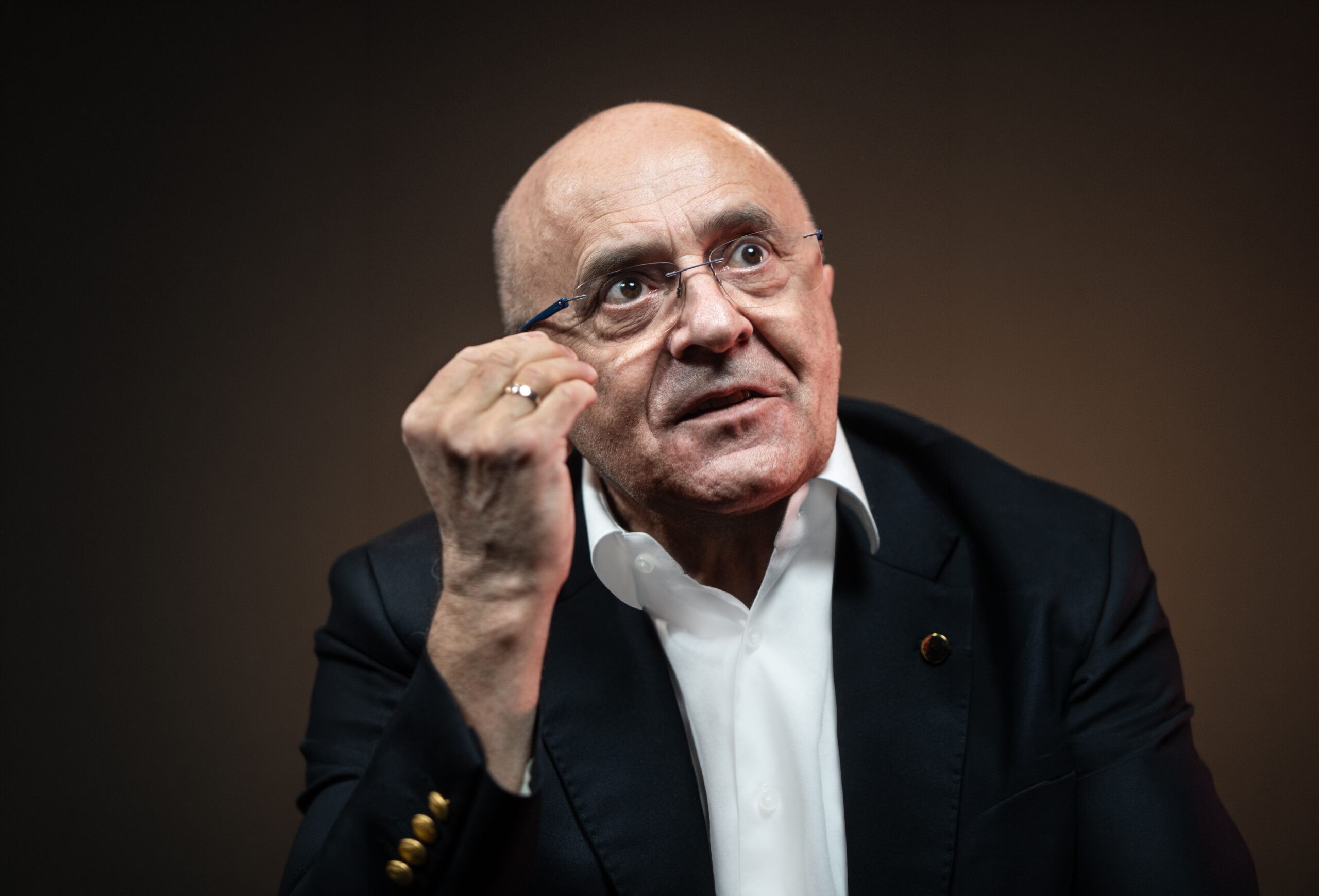
He wanted to be a gardener, was fascinated by reinforced concrete and rebar, loves music—especially the Beatles—and today designs homes that are like session music. Leszek Kalandyk, an architect and owner of LK&Projekt Architects, talks about why designing houses is so difficult and how he prepares to fulfill dreams.
photographs: Bartosz Maciejewski
When did you realize that you see the world differently than others?
Quite early—already in childhood. Back then, I wanted to be a gardener. I saw a lot of flowers around me and couldn’t get over their beauty, diversity, and colors. My mother taught me how to look for beauty. She was a certified seamstress; she paid attention to sleeves sewn into a dress or coat and pointed out what had been done clumsily. I remember a drawer full of buttons. I was amazed by the number of ideas for buttons and their finishes. My mother worked, and I sat next to her and drew. She would set a porcelain teapot or other objects in front of me and encouraged me to draw. Sometimes I got a real scolding when I didn’t reproduce something well. That was my awakening.
Those were the times of the “proper system.” Shaped at home, walking down the streets I couldn’t be indifferent when I saw a sidewalk laid crookedly, or curbs that were uneven. It irritated me, but I also started noticing beautiful things. I had the chance to live in a prewar housing estate designed by good architects in the style of Polish interwar modernism. I could look at wooden entrance doors to an apartment building. The interior stair railing was beautiful, as were the terrazzo and the clinker tiles. I was lucky to be around good detail.
Was that when your love of architecture was born?
I was interested in construction sites. On Saturdays or Sundays I would sneak through torn fences onto building sites. I loved taking pictures of structures. The more exposed reinforced-concrete elements or rebar, the more fascinated I was. From the beginning I also painted. I regularly came down with strep throat, and when a person’s body temperature is elevated, the brain works better. That’s when I painted best. The obvious choice for me was an art-technical school. It was ’69, the end of the Gomułka era. My father asked me whether I could support a family with painting. He always approached that question practically. He encouraged me to choose the best construction technical school in the province. I chose it and I don’t regret it. It was the best school I could have gone to. The teaching staff was at the level of polytechnic universities. The only pity was that the classes were not co-ed. There were 49 of us, and after technical school everyone finished construction studies—only two from that class went a different way. A friend became a gynecologist, and I became an architect. Everyone ended up on major construction projects all over the world. The technical school gave a solid foundation; it was better than university studies. I imagined university as a monastery where the spirit is trained in discipline and knowledge. That’s where refinement should happen—reaching mysteries, studying the world. I was disappointed.
Why did you choose architecture?
Because I love music. I finished music school; I play the accordion. I see
a huge connection between music, mathematics, and many fields, but especially architecture. Why do I talk about music? Because music is easier to explain. Architecture is difficult to understand, which is why there is a lot of loneliness among architects. I wanted to practice a profession that cannot be defined in words. Good music—for example, the Beatles—cannot be described. The Beatles are my love. The Beatles made me who I am, and that’s why I also wanted a profession that can’t be described in words. Architecture is like music. We see it; it can move us, give us chills, but we don’t fully know what it is. Many books have been written about the Beatles, yet no one is able to define their phenomenon. I’ve lived with their music my whole life and I think it is so wonderful because it was created out of love for another person.
So a house, like a piece of music, should have its own rhythm, tempo, pauses?
Good architecture has—and should have—rhythm, a dominant element, silence, form, just as a musical piece does. All of that belongs to architecture as well. What is rhythm? It’s the beating of the heart. Music cannot exist without rhythm. In music and architecture there are variations on a theme, repetition… You can play with analogies for a long time, but it brings you closer to understanding architecture.
Did your first house have the best musical qualities?
No, that isn’t easy to achieve. People say a good architect is in his 50s, maybe even his 60s. Life showed me and wrote an equation: beauty equals good. That is true, because truth is beautiful. The simplest things are the hardest. Many people think designing a house is a trivial matter. Even many academics don’t deal with this topic at all. But after years of experience, I believe that a single-family house is one of the most difficult architectural subjects.
What does that difficulty come from?
A house is personal. It shapes and changes our lives. We shape the house, and then it shapes us and affects our health, life, career, our love. Our future, our heritage—everything. A house is power. It contains an enormous amount of knowledge that we should gather before we begin the design. You can’t learn that in a short time; rather, you need to study for your whole life. A house is also a reflection of the reality around us, so the architecture of a house is also observation of life—of what is happening. A house is also comfort, which throughout history was not always obvious. Architecture should create beauty, a play of light, masses. Because of the ugliness around us today we no longer notice it, but we should create beautiful places—homes integrated into their surroundings.
Today people ask me for the whole package at once: the house, the interior, the garden, and the fence, which is a certain boundary between the sacred and the profane. Sometimes people complain that their plot is uninteresting. Yet everything can be designed and executed beautifully. That happens. Today the possibilities are enormous, but as with anything, they must be used wisely.
A house must be a work of art, because we return to it every day, every day we press the door handle. A house carries so much meaning and symbolism. Gripping the handle is like shaking another person’s hand. A house is building another person. There is no better teaching body than the family home. Children absorb everything like a sponge. When they can go outside, see nature and the surrounding world, those impressions stay with them for the rest of their lives. Sitting at a shared table, conversations… In the 1970s, in a “jamnik” apartment there wasn’t room for a normal dining table.
A person’s future can depend on the room they live in. If someone who’s passionate about building model airplanes has a tiny room, they won’t develop. And what if someone wants a large home library? In the old days it was understood that a library had to be in the house. A house is priceless. The point is to create beauty, which begins at the entrance. That’s what I do. Andrea Palladio was already doing this in the 16th century when he designed villas. He drew knowledge from the Roman architect Vitruvius about the energy that governs a house and buildings. He believed that masculine and feminine energy consistently flow from the north and the east. These energies mix. Many homes, many beautiful places, are created for women. From 45 years of my experience, in 95 percent of cases it is women who decide about the house
—they choose it. They know what they want, because women have an incredible sense of comfort, good taste, and style—and everything is built on that.
What does the process of designing a house for a specific person look like?
It is very difficult and very interesting at the same time. In the case of residential architecture, it is a multi-year process. If I designed a modern house for someone for whom it would be a collision with a space that doesn’t fit their psyche, I could harm them. Persuading an investor toward a specific architectural style is the biggest mistake and a misunderstanding. We have to talk. Listening to investors is 50 percent of inspiration. We don’t realize what great ideas people have for how to use a home, which is why I listen to investors very carefully. I do it like a session musician compared to a musician who plays only what he learned. If I need to play blues, I play blues. If I need to play rock ’n’ roll, I play rock. An architect must be flexible and must be exceptionally capable in his profession. Let’s assume an investor wants a house in a Japanese style. To take it on, I have to study Zen philosophy and Japanese culture. If I’m not able to do that, I refuse.
An architect is also there to suggest certain solutions. Let’s look, for example, at the kitchen, which is like a pharmacy—of course symbolically. What we eat makes us die slowly or quickly. That’s why the technology and organization of the kitchen are especially important, including in terms of the energies I mentioned earlier. It’s important not to place the stove next to water. When fire and water are close, there will be fights in the house. Imagine dishwashing. It’s a boring activity. What do we look at while doing it? It can be made interesting. Another issue— the pantry. Polish smoked sausage can’t be placed where a gelatin cake is prepared. So one refrigerator should be for fruit, vegetables, and dairy, and a separate one for meat, etc. Notice how many issues arise in a single kitchen.
Returning again to energy: sometimes the front door opens outward, like at Biedronka. But a home is not a mass-evacuation facility! When opening the door to a home, we should make a welcoming gesture—not push guests out. Often, after entering, you run into
a wall. All the energy is blocked, when it should be able to flow freely. We should be able to enter together and dance, not collide with a wall.
Do your designs fulfill people’s dreams?
I do, but I’ll return once more to the matter of energy. Let’s imagine that when we enter a house, we immediately face the door to the toilet. And what then? All the energy goes straight into the sewer pipe. My goodness, how many such houses there are! Later people get sick, suffer, there is no happiness, they get divorced—and that is the effect of the house. I say this completely seriously. I’ll also suggest something about the bedroom. What happens when
a home office is located next to the bedroom? Those are two different energies, and you can’t dream beautifully when next door there’s a room dominated by work and agitation. When you enter a church, you feel the right atmosphere—what has been prayed into it. That’s
a different energy than outside.
In the places where we are, we leave our energy. That’s why in Warsaw, in Kraków, or in other cities where artists walked—Wyspiański, Malczewski, and many others—we feel that different energy. That’s why I would never buy a bed from a person I don’t know. Old things have their own memory. I tell investors about this, and it opens their eyes. That’s how we achieve the final effect. HOME.