
Studies 2026: Student finances under scrutiny
Studying in Poland is becoming more expensive. Average monthly student spending is now nearly PLN 4,050. How are future master’s degree holders coping with the rising cost of education? What depends on them, what depends on their parents, and what depends on financial institutions and possible state support? One thing is certain: paid work is increasingly what allows student budgets to balance.
The latest research shows that the cost of studying has risen on average from PLN 3,979.22 last year to PLN 4,045.82 this year. Accommodation, tuition and food have for years remained at the top of the list of monthly expenses.
„Students are feeling the pressure of living costs more strongly and are approaching budget planning more carefully. Although their financial condition is not changing dramatically, there are some signs of a deterioration in sentiment. Fewer people than a year ago assess their situation as rather good, while more view it negatively. It is also worth noting that 30 percent of respondents describe their financial situation as comparable to that of their peers”, analyzes Przemysław Barbrich, Director of the Communication and PR Team at the Polish Bank Association. „We are observing that many students combine studies with work, and this is a clear change compared with last year, when professional inactivity increased in this group. Today, professional activity is becoming an important element of building financial independence for many students, as well as a way to cope with rising living costs”, he adds, summarizing the latest Polish Bank Association report, „Student Wallet 2026”.
Most live on the statistical half
When looking at the overall cost of studying, it is worth taking a closer look at the category of „monthly student living costs”. A budget of up to PLN 2,000 remains the most frequently indicated level of spending (60 percent of respondents, 5 percent less than a year ago). At the same time, nearly one in four respondents (23 percent) incurs monthly costs of PLN 2,001 to PLN 3,000, while 5 percent of students declare expenses exceeding PLN 4,000 per month.
Such differences in the monthly budgets of young people are influenced by various factors, but the key ones are the place of study and the financial situation of the family. Warsaw, where one in five students studies, is the largest and most expensive academic center. „The high cost of living in the capital means that as many as 42 percent of respondents still live with their family, and 79 percent receive financial support from their parents”, according to a survey carried out by students of the SGH Warsaw School of Economics.
The data are shocking
Official government reports reveal a gigantic number of people, more than 1.3 million, who dropped out of higher education without obtaining a diploma and did not resume their studies within a year. In some popular but demanding fields, the dropout rate ranges from 40 percent to as much as 60 percent. Often the reason is an accidental choice of field of study. However, one of the causes of dropout is also the cost of studying. Average monthly student spending has increased by 50 percent over five years. „In 2025, nearly one in five students considered giving up their education because of their financial situation”, reports the Ministry of Science and Higher Education. To help sustain students’ willingness to continue studying, the ministry launched the nationwide system for monitoring the economic careers of university graduates, known as ELA (ela.nauka.gov.pl/pl/home). It allows users, among other things, to quickly verify whether graduates of a selected field at a specific university spend a long time looking for work and how much they earn.
More than half combine work with studies
Working while studying is becoming natural for young people. More than half of students (58 percent) are professionally active. 54 percent of them work for pay, while the remaining 4 percent run their own business. Work is no longer merely a casual occupation: 30 percent work full time, while 31 percent work part time or occasionally, according to the „Student at Work” survey conducted by SW Research as part of the Career Program of the Polish Business Roundtable. The average earnings of a working student in Poland currently amount to PLN 4,128 net.
Who can get a student loan?
In Poland, it is possible to use a student loan. Polish citizens and foreigners with a specified residence status, such as permanent residence or the Pole’s Card, may apply for one. However, it should not be confused with a student loan in, for example, the United Kingdom or the Netherlands. How does it work here? It is primarily support for financing expenses. It is available to people up to the age of 30 in the case of students and up to the age of 35 in the case of doctoral students at the time of applying. The monthly net income per person in the applicant’s family may not exceed the current ministerial limit of PLN 4,000 net. Applications are not submitted at universities, but at designated banks: PKO Bank Polski S.A., Bank Pekao S.A. and associations of cooperative banks (BPS and SGB-Bank). The student decides what amount they need each month: PLN 400, PLN 600, PLN 800 or PLN 1,000. The money is paid out for 10 months of the academic year.
Since 1998, when the program began operating, banks have signed nearly 411,000 loan agreements in total. At Bank Pekao S.A., about 3,700 people currently use student loans. „For students, it may be a challenge to present reliable income documentation for family members and secure repayment of the loan. A BGK guarantee is available provided that monthly income in the 2025/2026 academic year does not exceed PLN 2,500 net per person in the family”, says Maciej Dąbrowski, Director of the Retail Credit Products Department at Bank Pekao S.A.
The bank also grants student loans to foreigners if they belong to a legally eligible category of foreign nationals. As the Bank Pekao S.A. expert explains, this is rare, because applications for loans from foreign students occur only sporadically. When they do, they usually concern students from Ukraine.
On student forums, some say that the loan involves too many formalities and that the maximum amount has not been indexed for years, but: „Without the loan, I would not have studied full time. In my third year, I also took on additional work, which allowed me to have a good student life. You repay half of what you took each month, two years after graduation”, says Janek, who used this option. Repayment of the loan begins two years after graduation or after discontinuing studies. If a student graduates among the top 10 percent of graduates at their university, they may apply for statutory cancellation of 20 percent to even 50 percent of the debt.
Buy and do not forget to pay
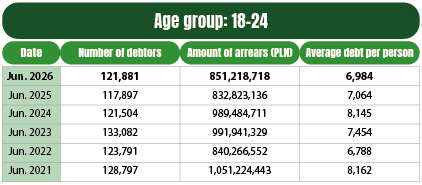
Loans, however, are not everything. „People just entering the labor market use classic credit products less often, but more often finance everyday expenses through deferred payments, subscriptions or usage fees. As a result, the debts that end up in debt registers are mainly delayed non-credit arrears related to everyday functioning, such as phone bills, internet, utilities, rent, as well as unpaid fines for riding without a ticket. There are also cases of alimony”, comments Waldemar Rogowski, PhD, chief analyst at BIG InfoMonitor and BIK. Non-credit unreliable debtors aged 18-24 visible in the BIG InfoMonitor database account for as much as 73 percent. Today, the average debt amounts to PLN 6,984.
Young people most often fall into debt because of difficulties in paying current obligations on time. „As they enter adulthood, they make their first independent financial decisions and begin to bear the costs of maintaining an apartment, transportation or telecommunications services. At the same time, they usually have lower incomes than older people, which means a smaller financial safety margin in the event of unforeseen expenses or a deterioration in their material situation. High inflation and the rise in living costs in recent years may also have contributed to deepening financial problems. As a result, even relatively small arrears can grow over time and end up in debt registers”, adds Waldemar Rogowski.
Health comes first
For students, insurance is very important. In Poland, a student should first be registered for health insurance as a family member, through parents, grandparents or a spouse. If this is not possible, the university handles it. And what about foreign students? „A student must have a visa and health insurance. That is the foundation. However, the rules under which they can use public healthcare, the National Health Fund, depend on their citizenship”, explains Ewelina Ratajczak, insurance expert at Rankomat.pl.
For students from the European Union or EFTA, it is enough to have an EHIC, the European Health Insurance Card, issued in their home country. It entitles them to free treatment in Polish National Health Fund facilities, but only to the extent medically necessary, for example in the case of a sudden infection or a fracture. Ratajczak explains that EHIC does not cover, for example, previously planned procedures or medical transport back to the home country.
„The situation is different for students from outside the EU, for example from Ukraine. They do not have an automatic right to free treatment in Poland. They can, however, sign an agreement for voluntary health insurance with the National Health Fund. The cost of such insurance for a student is PLN 55.80 per month. This requires submitting an application independently at a National Health Fund branch, registering with ZUS using the ZUS ZZA form and paying the contribution every month”, says the Rankomat.pl expert.
„An exception applies to the Pole’s Card or documented Polish origin: students from third countries, for example from Ukraine, who hold a Pole’s Card or have documented Polish origin are exempt from National Health Fund fees. In their case, the health insurance contribution is paid in full by the Polish university. It is enough to report this fact to the dean’s office”, Ratajczak emphasizes.
Safe also within four walls
Regardless of whether a student rents a room, shares an apartment with friends or lives in a dormitory, a burst pipe, an electrical short circuit or theft of belongings can become very costly overnight. The Rankomat.pl expert points out that tenant liability insurance protects against the financial consequences of damage unintentionally caused to the property owner or neighbors, for example flooding an apartment due to a burst washing machine hose. Another issue is protection of private property, or household movable assets: it protects a student’s personal belongings, including expensive electronics such as a laptop, phone or camera, clothing and documents, in the event of burglary, fire or flooding. Home Assistance can also be useful, a support package that provides quick intervention by a specialist, for example a locksmith after losing keys, without the need to bear high private repair costs. Everything depends on needs and financial possibilities.