
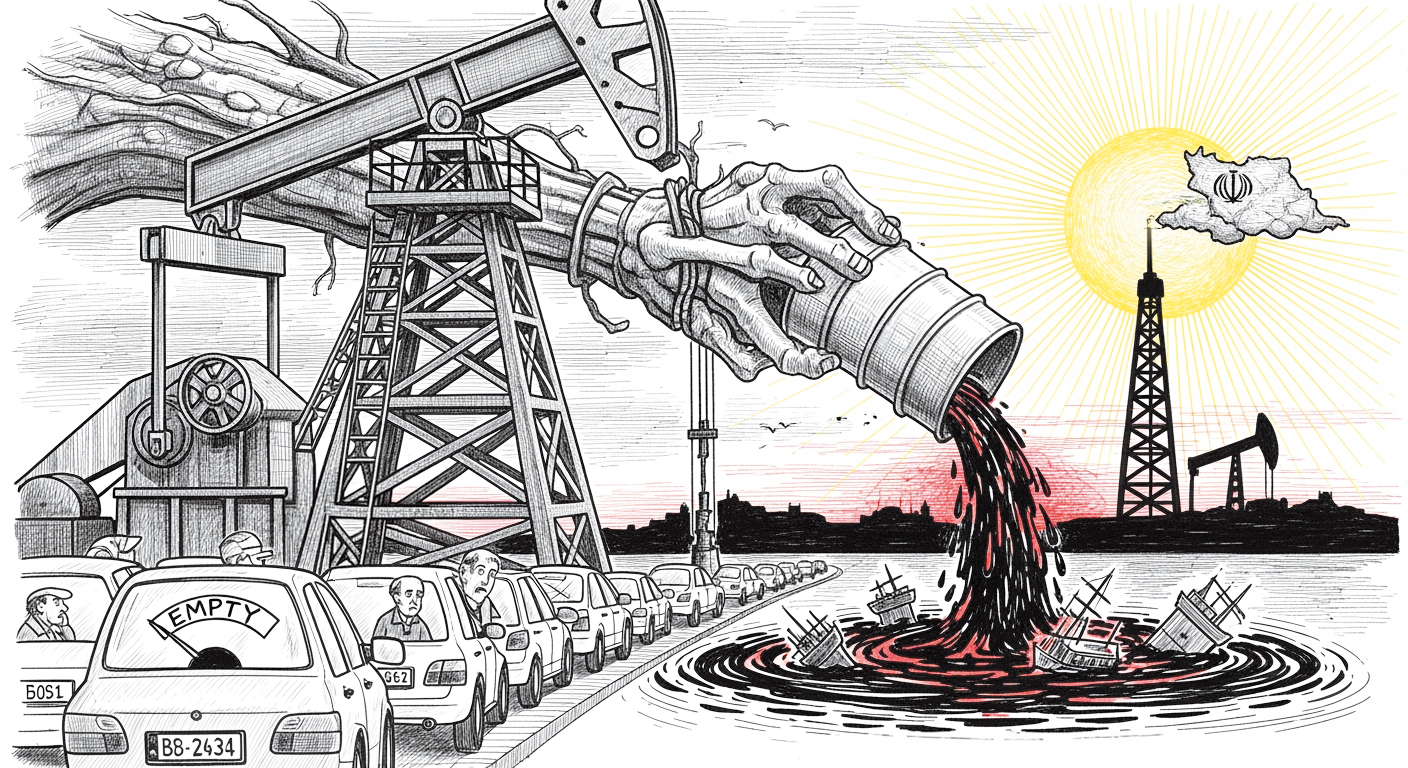
Iran and Rising Fuel Prices
There are currently no indications to suggest that fuel prices will rise to a level that would prevent drivers from filling up.
However, increases are practically inevitable and may become noticeable within the next few days. Given the current market situation, the likely scale of the rise is several dozen groszy per liter for both gasoline and diesel. This means that prices around 6 PLN per liter could become the new market norm.
At the same time, the risk of the conflict involving Iran dragging on is increasing. Iran’s armed forces, including the Islamic Revolutionary Guard Corps, have announced an intensification of operations after a mourning period following the ayatollah’s death. In a scenario of prolonged escalation—lasting months or even years
—the consequences for global oil supply could be serious. It is already clear that tensions are affecting not only the direct parties to the conflict, but also the security of commodity transport throughout the region.
The key issue remains the Strait of Hormuz, through which a significant portion of the world’s oil exports from Persian Gulf countries flows—such as Saudi Arabia, the United Arab Emirates, Kuwait, and, to some extent, Iraq. Even without a formal military blockade, heightened risk
to shipping is enough for insurance companies to refuse coverage for oil transport. In such
a situation, some deliveries could be halted for purely economic and logistical reasons. As for the security of supplies to Poland, the authorities and fuel companies assure that the country has crude oil and fuel reserves sufficient for roughly a month and a half. Poland also relies on diversified supply routes, which limits the direct risk of shortages. The problem, however, remains the price —this depends on the global situation and may rise gradually as uncertainty persists.
It is worth emphasizing that Iran itself is not a key supplier of oil to Europe—in recent years, among other reasons due to U.S. sanctions, it has exported crude mainly to Asia. More important would be any potential restriction of supplies from the entire Persian Gulf region, as well as LNG shipments from Qatar, which also depend on the security of maritime routes.
Alternatives do exist, including supplies from the North Sea, West Africa, or the United States. In addition, OPEC countries have announced increased production, although the effectiveness of these measures will depend on the ability to export safely. For now, the global oil market is not experiencing a physical shortage, but a prolonged conflict could disrupt that balance.
In summary, we are not currently facing interruptions in fuel supplies, but higher prices are a highly likely scenario. The scale of the increases will depend primarily on the duration and intensity of the conflict in the Persian Gulf region.