
Poland as Europe’s Logistics Gateway
Direct access to one of Europe’s most important transport routes enables efficient distribution to Central Europe – including the Czech Republic, Slovakia and Hungary – as well as to the Baltic states.
Just over a dozen years ago, Poland was regarded by many international corporations primarily as an attractive manufacturing location thanks to its competitive labour costs and the wide availability of workers. Today, this picture has changed fundamentally. Increasingly, Poland is becoming the distribution centre for goods destined for a significant part of the continent, and our country is becoming one of the most important links in European supply chains. Modern logistics is no longer limited solely to transporting goods from point A to point B. It encompasses inventory planning, warehousing, order fulfilment, value-added services, e-commerce support and information flow management. It is precisely in this area that Poland has built one of its greatest competitive advantages.
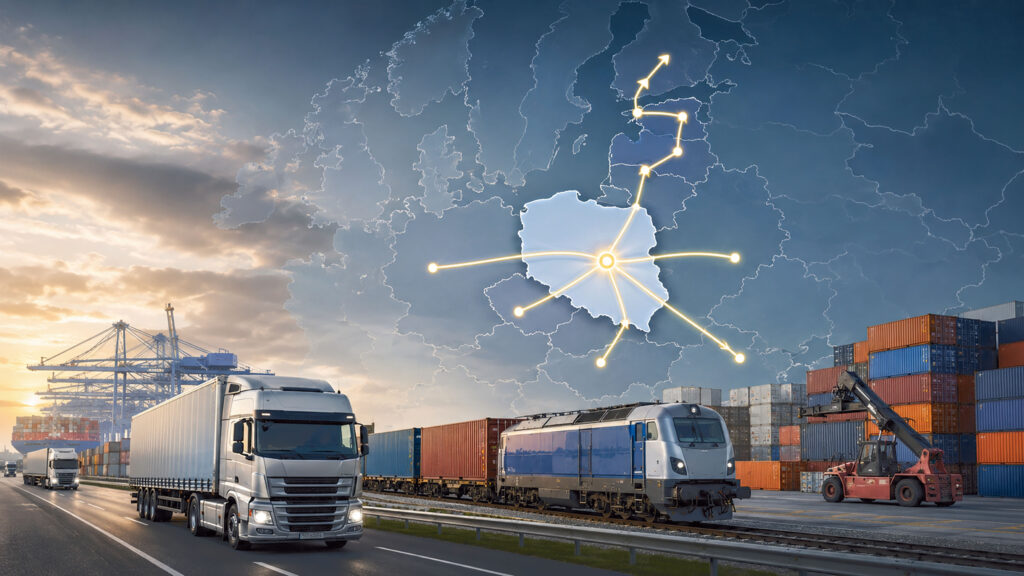
For many years, Poland’s geographical location has been recognised as one of the country’s natural strengths. Poland lies at the intersection of Europe’s most important transport corridors, connecting Germany with Central Europe, Scandinavia with Southern Europe, the Baltic states with the south and west of the continent, as well as the markets of Western Europe with Ukraine and the remaining countries of Eastern Europe. However, location alone would not have been sufficient to achieve its current position. Success has also been driven by investments in infrastructure, the development of modern logistics parks, warehouse automation and the experience of logistics operators serving customers from almost every industry.
Poland as the Centre of European Supply Chains
The COVID-19 pandemic, disruptions in global trade and geopolitical tensions have demonstrated to businesses how important supply chain resilience is. Many companies have begun shortening the distance between production and the end customer by relocating part of their operations closer to European markets. Trends referred to as nearshoring and friendshoring have placed Poland at the centre of investors’ attention.
From warehouses located in central Poland, goods can now reach most European Union countries within one or two days. For manufacturers, this means the possibility of reducing warehousing costs, responding more quickly to changes in demand and maintaining better control over inventory. Increasingly, Poland is no longer just one of many points on Europe’s logistics map, but is becoming the main distribution centre for entire regions.
The nature of logistics centres themselves is also changing. Until recently, a warehouse was primarily a place for storing products. Today, it functions as an advanced operational centre where goods are picked, repacked, labelled, personalised, prepared for promotional campaigns and shipped directly to end customers or retail chains.
Cross-Border Logistics – The Foundation of Modern Trade
The growing importance of online sales and the operations of international retail chains mean that cross-border logistics is becoming one of the key elements of the European economy. Cross-border logistics is far more than simply transporting goods across national borders. It involves the synchronisation of transport, warehousing, customs clearance, documentation management and maintaining a high quality of service regardless of the destination country.
For business customers, predictability is paramount. The mere fact that a shipment is delivered is becoming less important, while punctuality, real-time shipment tracking and the flexibility to respond to changing market needs are becoming increasingly significant.
Thanks to its extensive motorway network and central location, Poland has become the natural location for European distribution centres. From a single warehouse, it is now possible to efficiently serve customers in Germany, the Czech Republic, Slovakia, Hungary, Lithuania, Latvia and Estonia, while simultaneously reducing the number of warehouses maintained by manufacturers.
Wiskitki – An Example of a Modern Logistics Centre
A good example of this transformation is Wiskitki, located alongside the A2 motorway near Warsaw. The importance of this location extends far beyond serving the domestic market. Its proximity to one of Europe’s most important transport routes enables efficient distribution to Central Europe—including the Czech Republic, Slovakia and Hungary—as well as to the Baltic states. At the same time, its location in the Warsaw metropolitan area provides access to the largest consumer market in Poland, as well as to a well-developed business and labour base.
An additional advantage of the region is the ongoing development of transport infrastructure and the prospect of the Central Communication Port (CPK), which may further increase the attractiveness of central Poland as a European logistics hub in the future.
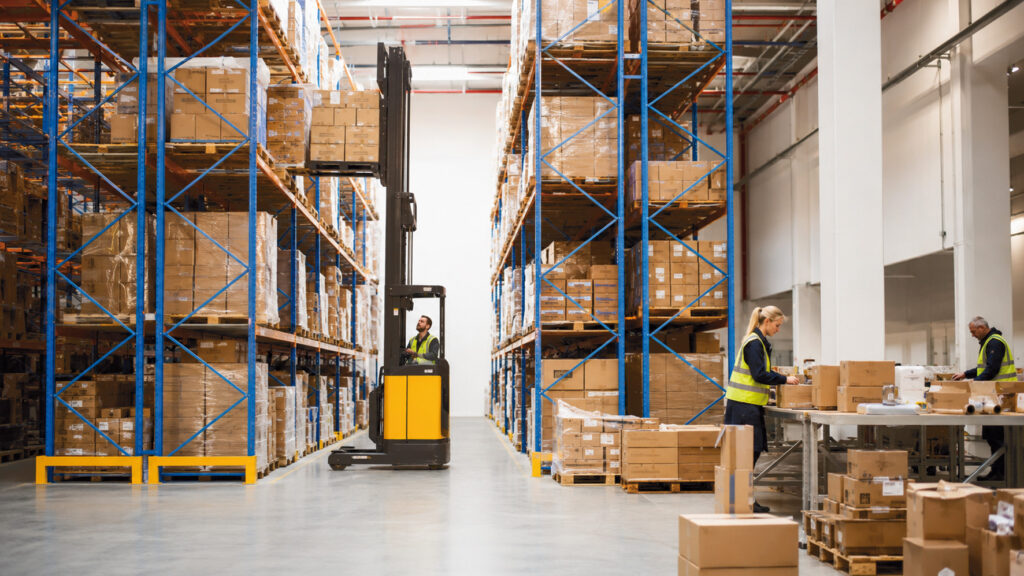
The logistics centres located in Wiskitki are among the largest facilities of this kind in the country. The total warehouse space used by Raben Logistics Polska amounts to approximately 117,000 m². The warehouses located there are as high as 15 metres, allowing warehouse space to be utilised much more efficiently than in standard facilities. The implementation of semi-automated VNA (Very Narrow Aisle) systems makes it possible to increase warehouse capacity and improve operational efficiency.
Contract Logistics – Much More Than Warehousing
For many years, the international Raben Group has been associated primarily with road transport. However, an equally important pillar of the company’s business is contract logistics. It includes warehousing, order fulfilment, inventory management, distribution and a wide range of VAS (Value Added Services), such as co-packing, labelling, repacking and the preparation of promotional kits.
It is precisely these value-added services that increasingly determine the competitiveness of logistics operators. Manufacturers no longer need to organise separate packaging or order fulfilment processes. All these operations can be carried out within a single logistics centre, from which the finished product is delivered directly to stores, distribution centres or end customers.
Raben Logistics Polska handles more than one million pallets and performs over 200 million VAS units annually. This demonstrates how significantly the role of logistics operators has evolved—from transport providers to partners managing a substantial part of their customers’ logistics processes.
DHL Supply Chain – Global Experience, Local Infrastructure
Another example of the transformation described above is the activity of DHL Supply Chain—one of the world’s largest contract logistics operators. The company is developing modern logistics centres in Poland, serving the automotive, pharmaceutical, e-commerce, retail and technology sectors.
Like other global operators, DHL Supply Chain focuses not only on warehousing but also on integrating the entire supply chain. This includes warehouse process automation, the use of robots, Warehouse Management Systems (WMS), data analytics, artificial intelligence and solutions that increase customers’ operational efficiency.
The growing importance of e-commerce means that logistics centres are increasingly processing thousands of small orders every day instead of handling only full pallet shipments destined for retail chains. This requires a completely different organisation of work and a much higher level of automation.
Green Logistics Is No Longer a Choice
One of the most important directions of the industry’s development remains sustainability. Regulatory pressure and customer expectations are causing companies to analyse the carbon footprint of their logistics operations with increasing precision.
Modern logistics centres use energy-efficient LED lighting, photovoltaic installations, energy recovery systems and intelligent utility consumption management. At the same time, operators are expanding their fleets of low-emission vehicles, investing in alternative fuels and optimising route planning.
Contract logistics also plays a significant role. Combining warehousing, order fulfilment, VAS services and distribution in one location makes it possible to reduce the number of transport movements between successive facilities, decrease the number of transhipments and reduce CO₂ emissions. Increasingly, it is a properly designed logistics process that delivers greater environmental benefits than simply replacing vehicles with electric ones.
The Industry Under Pressure
The logistics sector, however, operates under increasingly challenging conditions. The costs of energy, wages and investment financing are rising. At the same time, companies must adapt to new environmental regulations, changes in transport legislation and ESG reporting requirements.
Customers expect ever shorter order fulfilment times, complete process transparency and uninterrupted product availability. In practice, this means the necessity of investing in automation, digitalisation and the development of employees’ competencies.
An additional challenge remains maintaining a high quality of service while simultaneously reducing costs. Today, a logistics operator must at the same time be a carrier, a warehouse manager, an integrator of IT systems and an advisor helping customers optimise their entire supply chain.
Poland Strengthens Its Position
Everything indicates that Poland’s importance on Europe’s logistics map will continue to grow. This is determined not only by its central geographical location, but also by its well-developed road infrastructure, the increasing level of warehouse automation, the experience of logistics operators and the growing specialisation in contract logistics.
Examples of companies such as the international Raben Group and DHL Supply Chain demonstrate that modern logistics is much more than transportation. It is the comprehensive management of the flow of goods, information and services, aimed at shortening delivery times, increasing efficiency and reducing both costs and environmental impact.
If the current trends of nearshoring, digitalisation and the energy transition continue in the coming years, Poland has excellent conditions to become one of Europe’s most important logistics hubs a place from which not only the markets of Central Europe, but also those of Western Europe, Scandinavia, the Baltic states and the gradually recovering markets of Eastern Europe will be served. Increasingly, it is efficiently operating logistics centres, rather than factories, that are becoming the symbol of a modern economy and one of the most important sources of Poland’s competitive advantage on the European market.