Repeat to See
His experimentation was never only about searching for new techniques. Warhol used technology, repetition, chance and other people to constantly challenge his own way of creating.
Andy Warhol and the art of becoming anew
For several minutes, a person sits in front of a motionless camera. There is no role and no plot. They should, in fact, do nothing. Yet after a dozen or so seconds, a great deal begins to happen: a blink, a movement of the lips, a change in breathing, an attempt to hold a pose. The mask prepared for the camera slowly begins to crack.
This is how Andy Warhol’s „Screen Tests” work. Created mainly between 1963 and 1966, these short film portraits followed an almost laboratory-like principle: one person, a camera, light and time. Warhol limited his own interference, as if he were more interested in what would happen on its own than in what he himself could direct.
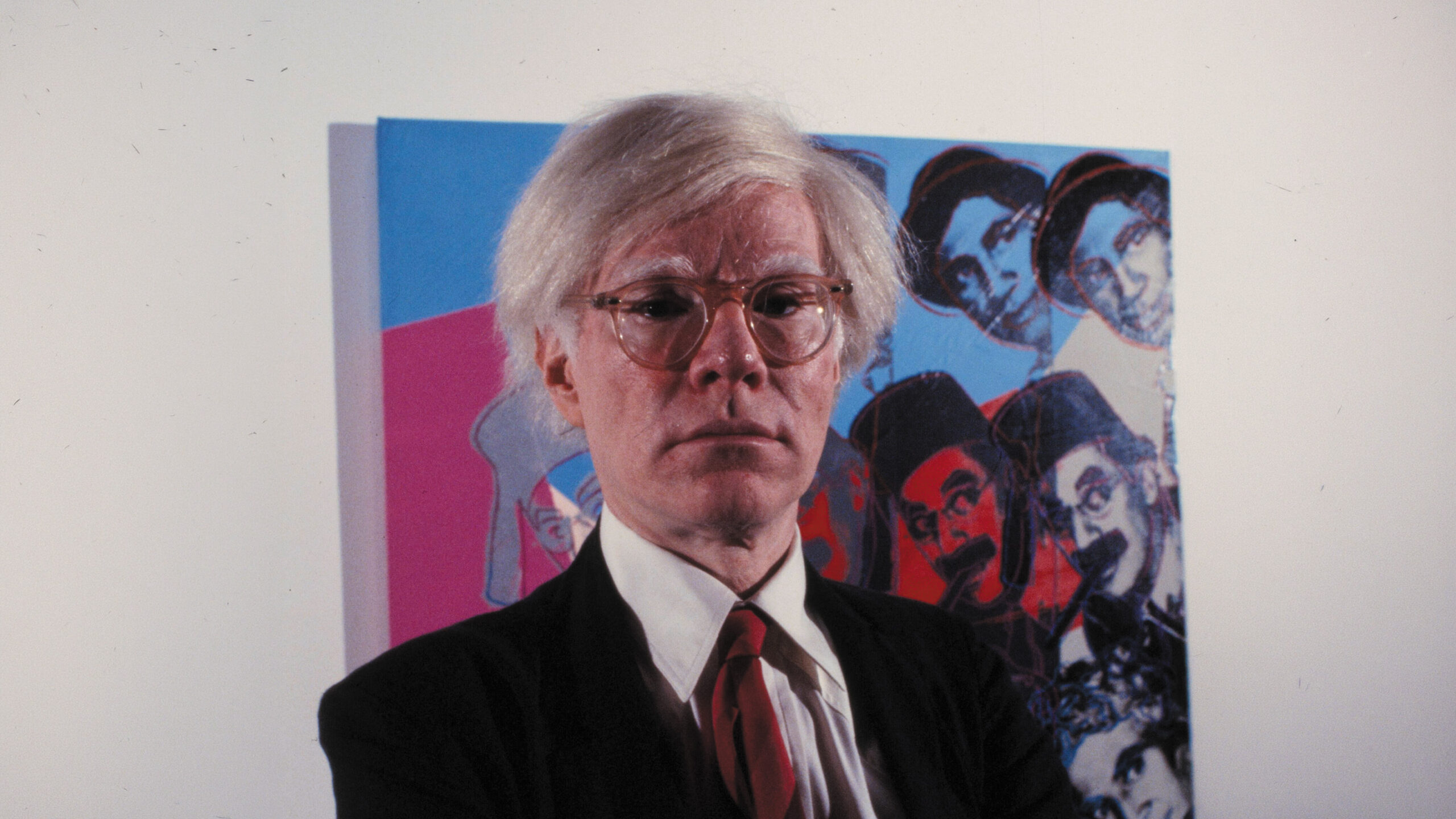
For me, this is where one of the most interesting Warhols begins. Not the Warhol of Marilyn and soup cans, but the artist who spent his entire life experimenting. He set the conditions, started the process and observed the result.
How much of one’s own hand can be removed from a work while still remaining its author? How many times can an image be repeated before it stops meaning the same thing? What will happen if we allow a machine to make mistakes?
Warhol kept returning to these questions. He merely changed the tools.
A line that is already a print
To see this, one has to go back to the 1950 s and the blotted line technique.
Warhol made a drawing, covered parts of it with ink and pressed it onto another sheet of paper. The result was a characteristic, delicately broken line. It looked spontaneous, but it was the result of transfer.
Already here, Warhol introduces a mechanism of reproduction between the artist’s hand and the final image. The same matrix could be used to create further versions, similar, yet never completely identical. This is important: repetition in Warhol’s work does not begin with silkscreen printing. It is present much earlier.
He would later say: „The more you look at the exact same thing, the more the meaning goes away”.
For him, repetition was not merely a way of producing a greater number of images. It was a method of studying the image. The first depicts a person. The tenth begins to become a pattern. The fiftieth may already become only a surface.
A machine that cannot copy
One of the most fascinating examples of this way of thinking is Mao from 1973, made with the use of a photocopier.
A photocopier promises identicality. Warhol used it in exactly the opposite way.
Successive copies were made from previous copies. The copy therefore became the original of the next generation. The image of Mao gradually lost sharpness, absorbed the errors of its predecessor and moved further and further away from the source.
A device created to eliminate difference began to produce that difference. This is particularly interesting in the case of Mao, one of the most frequently reproduced faces of the 20th century. Here, Warhol does not strengthen the icon. He allows it to disintegrate under the weight of its own reproduction. He observes Mao disappearing into his own copies. Once again, he shifts the boundary of authorship. He does not control every point of the image. He creates a rule and allows technology to do the rest.
When an image takes over a wall
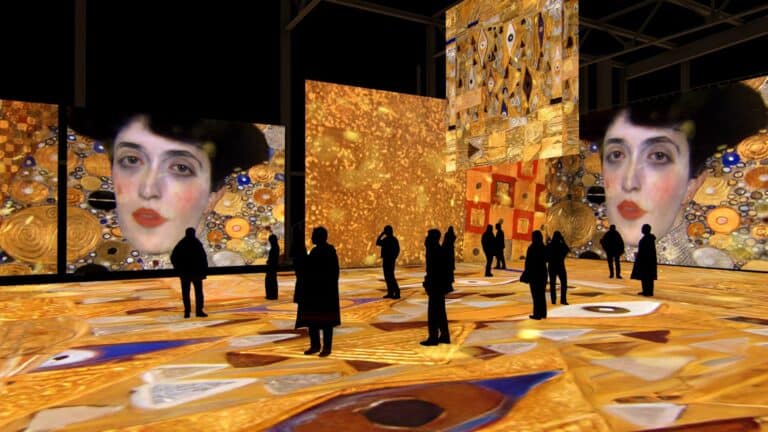
“Cow Wallpaper” works in a similar way. In 1966, pink and yellow cows covered the walls of the Leo Castelli Gallery. Instead of a single work, a pattern appeared. Instead of a painting on the wall, the wall became the painting. One cow is a depiction of an animal. One hundred cows begin to function as a visual system.
Warhol takes away another traditional feature of the artwork: its boundary. The frame is no longer needed. The image can spill over into architecture and surround the viewer. What began in blotted line as the possibility of another print here becomes space.
The portrait and its limits
The 1975 series „Ladies and Gentlemen” is even more complex. Warhol portrayed New York drag queens and trans women, mainly Black and Latino people. Initially, they were meant to be anonymous figures, not Factory celebrities, but people found in New York’s nightlife and photographed with a Polaroid.
Hundreds of paintings were created. Today, however, it is difficult to look at this series only as another example of Warholian multiplication. There is tension in it between visibility and anonymity. The people portrayed have an extraordinary force of presence, while for years their names remained outside the history of these works. It is precisely here that the limit of Warhol’s dream of an impersonal image is revealed. A machine may be neutral. Silkscreen can repeat a photograph, but the person standing in front of the lens is never merely material.
Then the banana appears
That is why this story is best ended with „Mario Banana”. Mario Montez sits in front of the camera and eats a banana. That is all. And at the same time, almost everything Warhol was interested in appears here at once. A motionless camera, as in the „Screen Tests”. A person who is simultaneously themselves and playing themselves. A banal object turned into a sign. The repetition of a simple gesture. Humor, camp, eroticism and conscious theatricality.
It is unclear where the portrait ends and the performance begins. Are we watching a film about Mario? About a banana? An erotic joke? Or perhaps an experiment testing how long one simple image can hold our attention?
Warhol does not answer. Perhaps this is precisely what remains most contemporary about him.
His experimentation was never only about searching for new techniques. Warhol used technology, repetition, chance and other people to constantly challenge his own way of creating.
First, he allowed the hand to lose full control over the line. Then he took uniqueness away from the image. He entrusted time to the camera. He allowed the photocopier to destroy resemblance. He allowed the cows to take over the wall. And for Mario Montez, it was enough to give him a banana and turn on the camera.
That is why these works can be viewed not as more „Warhol icons”, but as a record of an artist who never wanted to know himself once and for all. Each time, Warhol created a situation in which he could, for a moment, stop being the Warhol he already knew and see who would appear in the next print.